ASE Certified Brake Technicians: Why Professional Certification Matters
When it comes to brake service, the person doing the work matters just as much as the parts being used. Brakes are your vehicle's most critical safety system, and trusting that service to a qualified professional isn't just a preference: it's a smart decision for any vehicle owner. As part of our complete approach to professional brake services, understanding what ASE certification means and why it matters can help you make more informed choices about who works on your vehicle. In this post, we'll explain what it takes to become an ASE certified brake technician, what the certification process actually involves, and why that credential should factor into your decision when choosing a brake service provider in Rancho Cucamonga.
What Does ASE Certification Actually Mean?
ASE stands for the National Institute for Automotive Service Excellence: an independent, nonprofit organization that has been setting professional standards for automotive technicians since 1972. ASE certification is not a participation award or a simple online course completion. It's a rigorous credentialing process that requires technicians to demonstrate real, verified knowledge of specific automotive systems through standardized examinations.
For brake service specifically, technicians pursue the ASE A5 certification: the Brakes category within ASE's Automobile and Light Truck series. This exam tests knowledge across a comprehensive range of brake system components and service procedures, including hydraulic systems, disc brakes, drum brakes, parking brakes, and electronic brake control systems like ABS (anti-lock braking systems).
What the Certification Process Requires
- Work experience: Technicians must have a minimum of two years of hands-on automotive service experience before taking an ASE exam. This ensures the credential reflects real-world competency, not just textbook knowledge.
- Passing a proctored exam: Each ASE exam is administered through a secure, proctored testing environment. Technicians can't look up answers: they need to know the material.
- Renewal every five years: ASE certification doesn't last forever. Technicians must recertify every five years, which means staying current with evolving vehicle technology and updated brake system designs.
This combination of experience, examination, and ongoing renewal is what makes the ASE certified brake technician credential genuinely meaningful, not just a title on a business card.
Why Certification Matters for Brake Safety
Brake systems have become significantly more complex over the past two decades. Modern vehicles, especially luxury sedans, SUVs, and trucks, often feature multi-piston calipers, electronic parking brakes, integrated stability control, and sophisticated ABS systems that interact directly with other vehicle safety technologies. Servicing these systems correctly requires more than mechanical aptitude. It requires verified, structured knowledge.
An ASE certified brake technician has demonstrated that they understand how brake systems work together as a system, not just as individual parts. That matters because improper brake service, using the wrong parts, incorrect torque specifications, or inadequate bleeding procedures, can compromise your vehicle's braking performance in ways that aren't immediately obvious. You might drive away feeling fine, only to notice reduced stopping power during an emergency situation when it counts most.
The Risk of Uncertified Brake Work
This isn't about creating unnecessary anxiety: it's about understanding what professional standards are designed to prevent. When someone without formal training services a brake system, there's a higher likelihood of:
- Incorrect brake fluid selection or contaminated fluid left in the system
- Improperly seated brake pads leading to uneven wear or noise
- Overlooked rotor thickness variations that cause pedal pulsation
- Incomplete bleeding that leaves air in the hydraulic lines
- Missed wear indicators on drum brake components
None of these issues announce themselves immediately. That's precisely why the training and testing behind ASE certification exist, to build habits and knowledge that prevent subtle problems before they become safety concerns.
What ASE Certified Technicians Learn About Brake Systems
The educational path toward becoming an ASE certified brake technician is structured and comprehensive. Many technicians complete formal automotive service programs at accredited schools before pursuing certification. These programs typically include dedicated brake system coursework covering both theory and hands-on application.
Brake-specific training covers topics such as:
Hydraulic Brake Systems
Understanding how brake fluid transmits force from your foot through the master cylinder to each wheel's caliper or wheel cylinder. Technicians learn how to inspect hydraulic lines, identify fluid contamination, and perform proper brake bleeds to ensure consistent pedal feel and stopping power.
Disc and Drum Brake Service
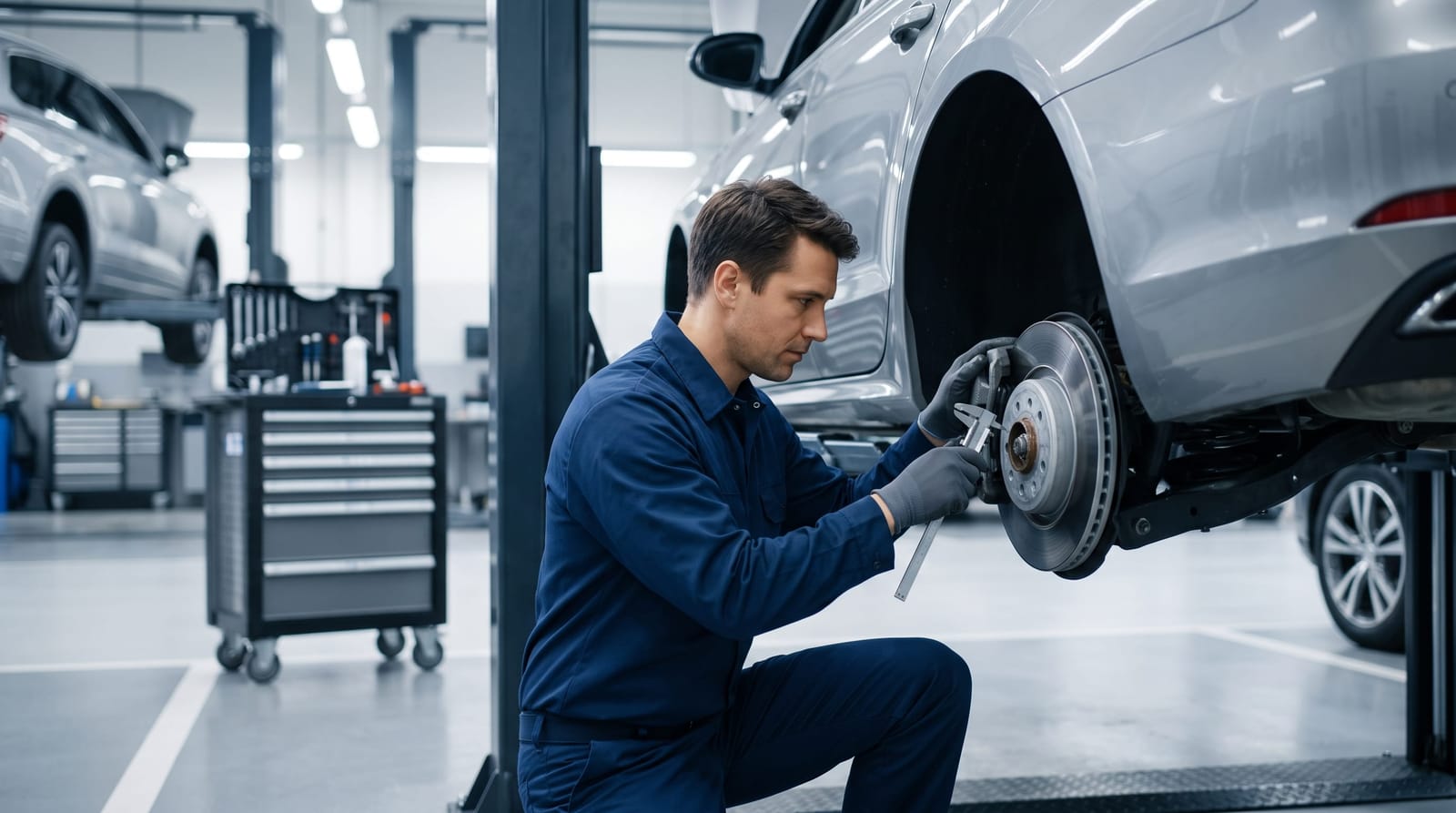
This includes measuring rotor thickness and lateral runout, evaluating pad wear patterns, inspecting caliper function, and correctly installing components to manufacturer specifications. Drum brake service adds complexity with return springs, adjusters, and self-energizing mechanisms that must be properly reassembled.
Electronic Brake Control Systems
Modern vehicles rely on ABS, traction control, and electronic stability programs that all interact with the physical brake system. Certified technicians understand how these systems communicate, how to interpret diagnostic codes, and how to service them without disrupting their calibration.
This level of structured knowledge is what separates a certified professional from someone with general mechanical experience. If you're having brake pad replacement done on a luxury or high-value vehicle, that distinction is especially important, because the stakes and the system complexity are both higher.
ASE Certification and High-Value Vehicles: A Closer Look
Owners of luxury vehicles, performance SUVs, and commercial fleet vehicles have even more reason to prioritize working with an ASE certified brake technician. These vehicles often use specialized brake hardware, larger rotors, multi-piston calipers, or electronic parking brake actuators, that require precise knowledge to service correctly.
For example, a luxury European sedan may require a specific brake fluid specification (DOT 4 or DOT 5.1) that differs from standard domestic vehicles. Using the wrong fluid can cause swelling of rubber seals in the hydraulic system. An uncertified technician might not know this distinction. A certified professional absolutely does.
Similarly, brake rotor service on premium vehicles involves understanding minimum thickness specifications set by the manufacturer, and knowing when a rotor is too worn to safely resurface, even if it looks acceptable to an untrained eye. Certification trains technicians to make these calls based on measured data, not guesswork.
Fleet operators face a different but equally important challenge: keeping multiple vehicles consistently maintained and road-ready. Fleet brake maintenance programs depend on technicians who can apply standardized, reliable procedures across different vehicle types: exactly the kind of consistency that certified training supports.
How to Verify an ASE Certified Brake Technician
Knowing that certification matters is useful, but knowing how to verify it before trusting a shop with your vehicle is equally valuable. Here's what to look for:
ASE Certification Credentials and Seals
Reputable shops that employ ASE certified technicians will typically display certification credentials in their waiting areas. Individual technicians may have certificates showing their specific areas of certification, including the A5 Brakes category. You can also ask directly: a professional shop should be able to confirm which technicians hold which certifications without hesitation.
The ASE Blue Seal of Excellence
Shops where a majority of technicians hold ASE certifications may qualify to display the ASE Blue Seal of Excellence: a recognized industry designation that signals a high standard of collective expertise. This isn't a guarantee of perfect service, but it's a meaningful indicator that the business takes professional development seriously.
Questions Worth Asking
- Does the technician working on my brakes hold ASE certification in brakes (A5)?
- How many years of experience does your brake service team have?
- Does your shop use manufacturer-recommended or OEM-equivalent parts for brake service?
A transparent, confident answer to these questions is itself a positive sign. You can also explore the broader question of whether all brake technicians are required to hold ASE certification, because the answer involves some nuance that every vehicle owner should understand.
What This Means for Brake Service in Rancho Cucamonga
For drivers in the Rancho Cucamonga area, finding an ASE certified brake technician means knowing your vehicle is being evaluated and serviced by someone who has formally demonstrated their expertise, not just someone who has worked on brakes before. The difference matters most when something unexpected is found during an inspection, when a repair involves a complex electronic system, or when you're driving a vehicle where brake system errors carry significant repair or safety consequences.
At Rancho Express Lube, brake service is handled by experienced, certified professionals who understand that this is never just routine work: it's the system that stops your vehicle when it needs to stop. Our team takes that responsibility seriously, and our approach to brake service reflects the kind of careful, qualified workmanship that your vehicle deserves.
Related Brake Service Topics Worth Exploring
If you found this overview helpful, there are several related areas worth learning more about as part of a complete understanding of professional brake services:
- The specific considerations involved in brake pad replacement for luxury and high-performance vehicles, including why part quality matters as much as installation quality.
- How brake rotor resurfacing compares to full replacement, and how a certified technician determines which option is right for your vehicle.
- The specific certification questions that arise in commercial and fleet settings, and what ASE certification requirements actually look like for brake technicians across different contexts.
Conclusion: Credentials You Can Trust Behind Your Brakes
Choosing an ASE certified brake technician isn't about chasing credentials for their own sake: it's about ensuring the person responsible for your vehicle's most important safety system has proven their knowledge through real examination and ongoing recertification. For owners of high-value vehicles, families relying on daily drivers, and fleet managers maintaining multiple vehicles, that level of verified expertise offers something genuinely valuable: confidence that the work was done right.
If you're due for a brake inspection or have concerns about your vehicle's braking performance, contact Rancho Express Lube in Rancho Cucamonga today. Our team is here to provide honest, professional brake service you can trust: backed by the training and credentials that make that trust well-placed.