Can You Service A/C in All Vehicle Makes?
If you drive a Honda, a Ford F-150, a Mercedes, or a heavy-duty work van, you've probably wondered whether your local shop can actually handle your vehicle's air conditioning, or whether you'd need to visit a dealership. It's a fair question. When it comes to AC service for all car makes, the short answer is yes, but there's more to it than that. Here's a practical breakdown of what modern A/C service covers, why it works across vehicle brands, and what to look for when choosing a shop.
Why A/C Systems Are More Universal Than You Might Think
Despite the wide variety of vehicle brands on the road, automotive air conditioning systems share a remarkably similar foundation. Whether you're driving a domestic truck or a Japanese import, your A/C relies on the same core components: a compressor, condenser, evaporator, expansion valve, and refrigerant lines. The basic refrigeration cycle that keeps your cabin cool is the same across virtually every passenger vehicle, SUV, and light commercial truck manufactured in the past three decades.
The most significant shared standard is refrigerant type. Since 1994, nearly all vehicles sold in the United States have used R-134a refrigerant. Starting around 2021, many newer models began transitioning to R-1234yf, a more environmentally friendly option. A properly equipped shop will carry both types and know exactly which your vehicle requires: that information is typically listed on a label under your hood.
This standardization is exactly what allows a qualified technician to service a Chevrolet Silverado in the morning and a Toyota Camry in the afternoon without missing a beat. The tools, the refrigerant handling procedures, and the diagnostic approach carry over cleanly from one brand to the next.
What Makes Some Vehicles Slightly Different to Service
While the fundamentals are consistent, there are genuine differences between vehicle makes that a technician needs to account for. Luxury and European brands like BMW, Audi, and Mercedes-Benz sometimes use more complex climate control systems with additional electronic components, dual-zone controls, or proprietary sensors that communicate with the vehicle's onboard computer. These systems require diagnostic scan tools that can read manufacturer-specific fault codes, not just a generic code reader.
Hybrid and electric vehicles add another layer of consideration. Because these vehicles don't always have a running combustion engine to drive a traditional belt-driven compressor, many use electrically driven compressors that operate at different voltages. Servicing the A/C on a Toyota Prius or a Ford Escape Hybrid requires technicians trained specifically in high-voltage safety procedures.
Commercial vehicles and work vans, common in fleet operations, often have larger A/C systems designed to cool a bigger cabin volume. These may use different refrigerant capacities and additional components like rear A/C units. A shop experienced with fleet vehicles will understand these differences and stock the right supplies to handle them properly.
None of these variations mean your vehicle can't be serviced: they simply mean it matters that your shop has the right training and equipment for the job.
The Role of Certified Technicians in Multi-Brand A/C Service
One of the most important things to look for when choosing a shop for A/C service is technician certification. ASE (Automotive Service Excellence) certification, particularly in the area of heating and air conditioning (Test A7), indicates that a technician has demonstrated competency across a broad range of vehicle systems and brands. According to the ASE, there are currently over 250,000 ASE-certified professionals working in the United States, and this certification specifically tests knowledge of refrigerant handling, system diagnosis, and component repair across vehicle types.
EPA Section 609 certification is another credential to look for. This certification is required by federal law for any technician who purchases and handles refrigerants like R-134a or R-1234yf. It ensures proper recovery and recycling practices that protect both the environment and the integrity of your vehicle's system.
When a shop employs certified technicians with access to manufacturer data and up-to-date diagnostic software, they can confidently service vehicles from nearly every major brand: domestic, import, luxury, and commercial alike.
What a Full A/C Service Typically Covers
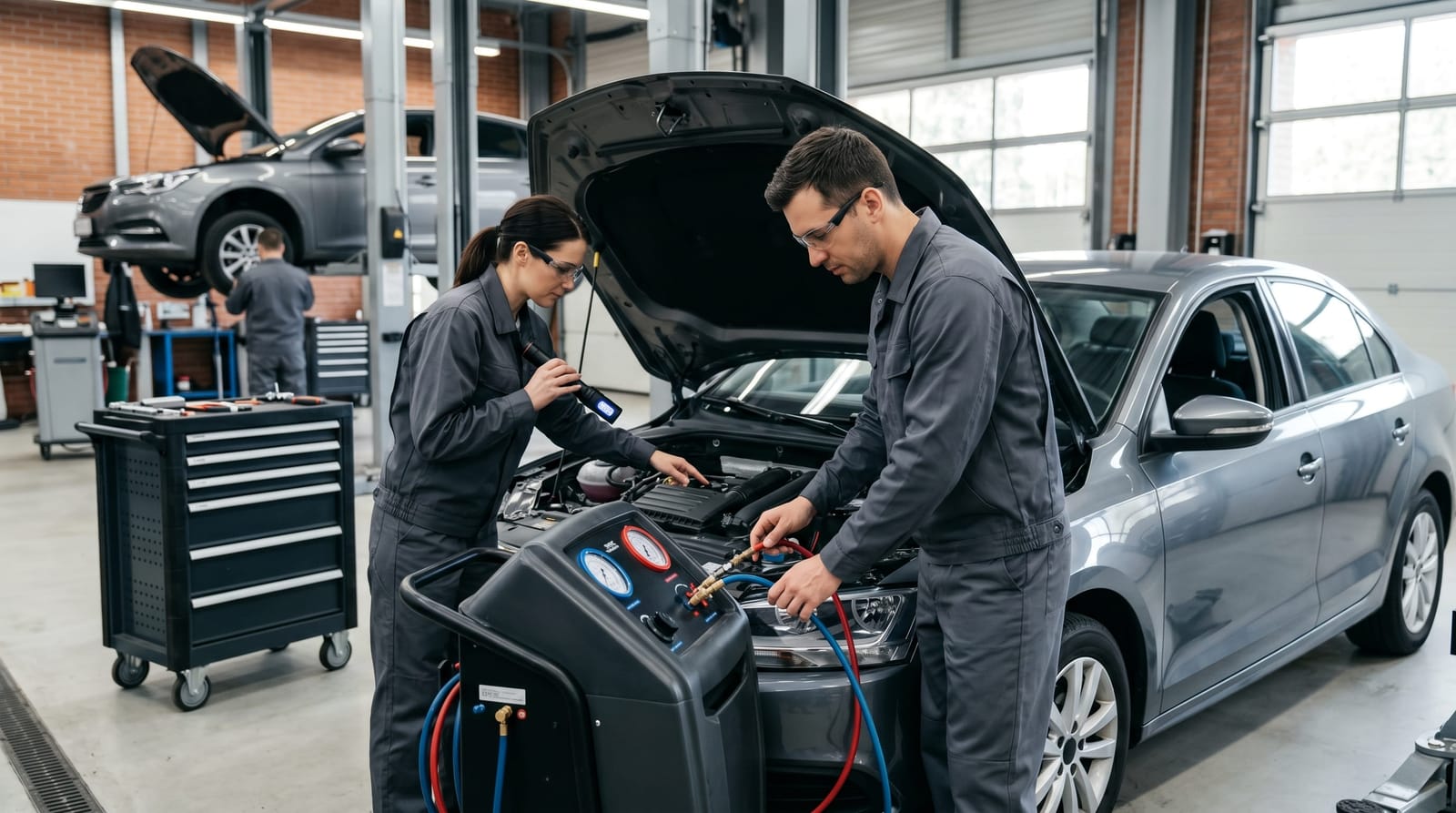
Regardless of your vehicle's make or model, a thorough A/C service should include a consistent set of steps. Understanding what's involved helps you know what to expect and ask about when you bring your vehicle in.
- System pressure check: Technicians connect gauges to measure high- and low-side pressure, which reveals whether refrigerant is low and whether the system is functioning within normal operating range.
- Leak detection: Using UV dye or electronic leak detectors, technicians check fittings, hoses, the condenser, and other components for refrigerant leaks. Studies suggest that approximately 10 to 15 percent of vehicles on the road have some degree of A/C refrigerant loss due to slow leaks.
- Refrigerant recovery and recharge: Old refrigerant is recovered using certified equipment, and the system is recharged to the manufacturer's specified capacity: a number that varies by make and model.
- Component inspection: The compressor, belts, cabin air filter, and electrical connections are checked for wear or damage.
- Performance verification: After service, the technician confirms that outlet vent temperatures are reaching the expected range: typically between 38°F and 45°F under normal operating conditions.
If you've been wondering about car AC blowing warm air causes, many of those issues, from low refrigerant to a failing compressor, are diagnosed and addressed during this type of comprehensive inspection.
How to Know If a Shop Can Handle Your Specific Vehicle
Before scheduling service, a few simple questions can give you confidence that the shop is a good fit for your vehicle:
- Ask about certification: Do their technicians hold ASE A7 or EPA Section 609 certifications? A reputable shop will answer this without hesitation.
- Ask about diagnostic tools: Do they have scan tools that cover your vehicle's make, including any proprietary systems? This matters most for newer, European, or hybrid vehicles.
- Ask about refrigerant types: Can they handle both R-134a and R-1234yf? If your vehicle is a 2021 or newer model, this is especially relevant.
- Ask about fleet or commercial experience: If you manage a fleet, look for a shop that specifically services commercial vehicles and understands the higher volume demands of fleet maintenance.
A good shop will welcome these questions. It's also worth noting that most quality service centers track A/C service history by VIN, which means they can reference your vehicle's previous refrigerant charges, any prior leaks found, and the work already completed: saving time and avoiding redundant service.
Frequently Asked Questions
Can a regular auto shop service a luxury car's A/C, or do I need the dealership?
In most cases, a well-equipped independent shop with the right diagnostic software can service A/C systems on luxury brands like BMW, Audi, Lexus, and Mercedes-Benz. The key is that the shop has access to manufacturer-specific scan data and employs technicians familiar with these systems. Dealerships are not the only option for quality A/C service on higher-end vehicles.
Does A/C service on a hybrid or electric vehicle cost more?
It can, depending on the type of system your hybrid or EV uses. Vehicles with electrically driven compressors require technicians trained in high-voltage safety protocols, and the service process differs from traditional belt-driven systems. It's worth asking your shop upfront whether they have experience with your specific hybrid or EV model.
How often should A/C be serviced, regardless of vehicle make?
Most manufacturers and service professionals recommend having your A/C system inspected at least once every two years, or any time you notice a change in cooling performance. Regular checks, including what's typically covered in an A/C system inspection, can catch small refrigerant leaks before they become larger, more expensive problems.
What's the difference between an A/C recharge and a full A/C repair?
A recharge simply replenishes the refrigerant in your system. A repair involves diagnosing and fixing an underlying issue, such as a leak, a failed compressor, or a clogged expansion valve, that caused the refrigerant loss or cooling failure in the first place. A recharge without addressing an underlying leak will only provide temporary relief.
The Bottom Line
AC service for all car makes is absolutely achievable at a properly equipped shop with certified technicians. While some vehicles, particularly newer hybrids, EVs, and luxury brands, have specific service requirements, the right shop will have the tools, training, and experience to handle them confidently. Whether you drive a family sedan, a work truck, or a high-mileage import, keeping your A/C system in good shape is a straightforward part of routine vehicle maintenance. If you're due for service or something doesn't feel right with your climate control, scheduling an inspection is the easiest first step.