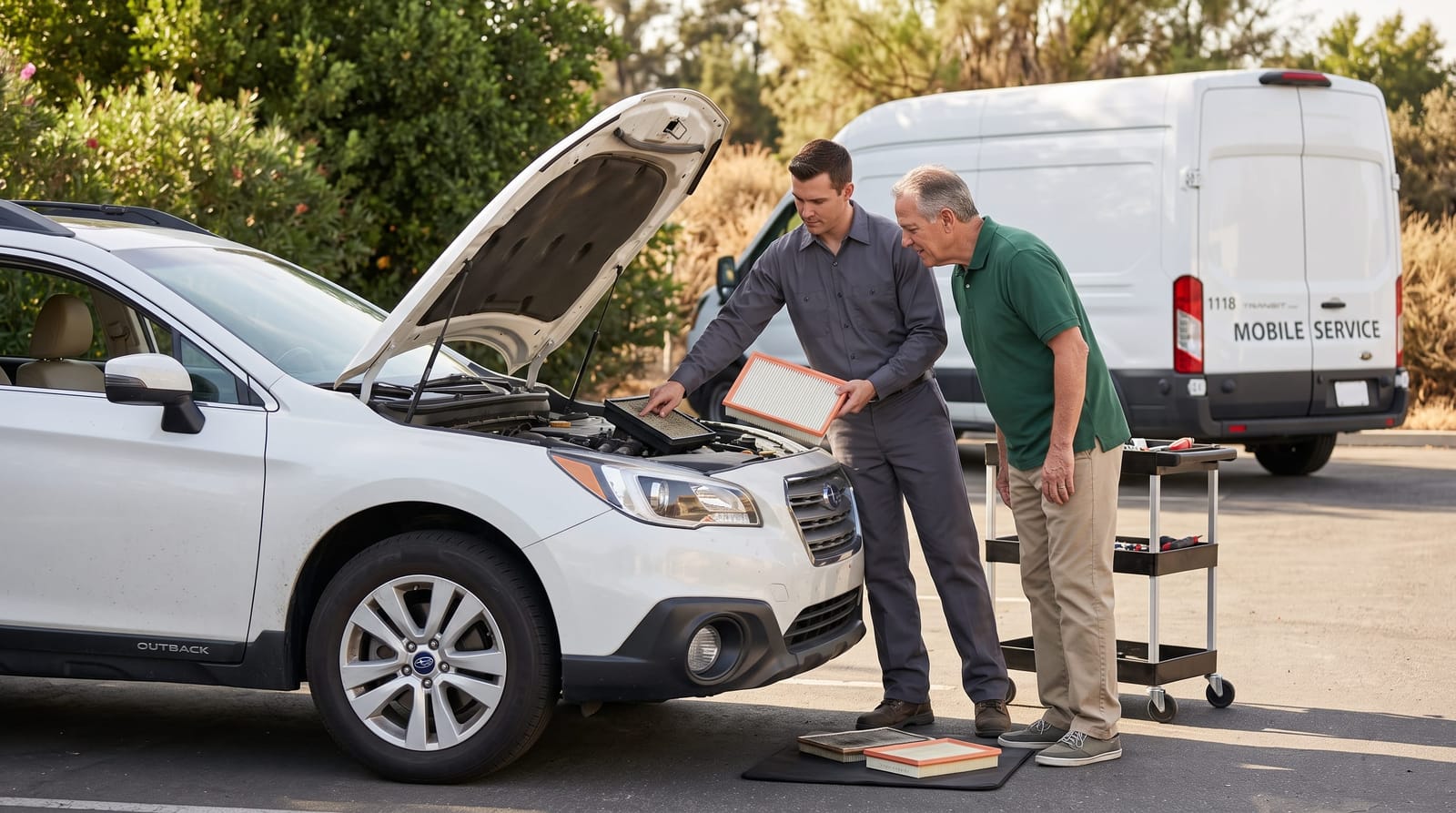
How Often Should You Replace an Engine Air Filter?

If you've ever wondered how often to replace an engine air filter, you're not alone: it's one of the most commonly overlooked parts of routine vehicle maintenance. Unlike oil changes, there's no dashboard light that tells you when your air filter needs attention. But keeping up with this simple service plays a real role in how smoothly your vehicle runs day to day. This guide breaks down the standard recommendations, the factors that can speed up wear, and what to look for during a quick visual check.
The Standard Replacement Interval: What Most Manufacturers Recommend
Most vehicle manufacturers recommend inspecting or replacing the engine air filter every 15,000 to 30,000 miles, or roughly once a year: whichever comes first. Some newer vehicles with tighter engine tolerances suggest staying closer to the 15,000-mile end of that range, while others may allow up to 30,000 miles under ideal driving conditions.
The best starting point is always your owner's manual. Manufacturers design their maintenance schedules around real-world testing for each specific engine, so that number isn't arbitrary. If you don't have your manual handy, a quick search for your vehicle's year, make, and model will usually pull up the recommended service intervals.
It's worth noting that "15,000 to 30,000 miles" is a guideline for normal driving conditions, and for a lot of drivers, especially here in Southern California, conditions aren't always "normal." That's where the next section becomes important.
Driving Conditions That Can Shorten Your Filter's Lifespan
Your engine air filter's job is to catch dust, dirt, pollen, and debris before they enter the engine. The more of that stuff that's in the air around you, the faster your filter gets loaded up. Several common driving conditions can push you toward the shorter end of the replacement window, or even beyond it.
Dusty Roads and Unpaved Surfaces
If you regularly drive on dirt roads, gravel paths, or dusty construction zones, your filter is working significantly harder than average. Drivers who frequently travel unpaved roads may find their filter needs replacement closer to every 10,000 to 12,000 miles rather than the standard interval.
Stop-and-Go City Driving
Frequent stops, low speeds, and idling in traffic mean your engine is pulling air through the filter for longer periods without covering much ground. If most of your driving happens in city traffic rather than on open highways, it's smart to inspect your filter more frequently, even if the mileage looks fine on paper.
Southern California Air Quality
The Inland Empire region, including Rancho Cucamonga, deals with some of the highest particulate matter levels in the country. Wildfire smoke, seasonal winds, and vehicle emissions all contribute to air that carries more debris than you'd find in cleaner environments. This is a genuine local factor that can reduce your filter's effective lifespan, and it's a good reason to check your filter at least once a year regardless of mileage.
Driving Through Agricultural or Industrial Areas
Pollen-heavy areas during spring, as well as industrial corridors with airborne particles, can also accelerate how quickly your filter becomes restricted.
How to Visually Inspect Your Engine Air Filter
You don't need to be a mechanic to get a general idea of whether your air filter is due for replacement. A basic visual inspection takes less than five minutes and gives you useful information between service visits.
- Locate the air filter housing. In most vehicles, it's a black plastic box connected to a large hose near the top of the engine bay. Consult your owner's manual if you're not sure where it is.
- Open the housing. Most air filter housings are held closed by metal clips or a few screws: no special tools required in most cases.
- Remove the filter and hold it up to a light source. A new filter looks white or light gray. A filter that has some use will appear darker but should still show some light passing through the pleated folds.
- Look for visible dirt buildup, debris, or damage. If the filter looks heavily clogged, if you can see large debris caught in it, or if the material itself appears damaged or misshapen, it's time for a replacement.
- Reinstall or replace. If the filter looks reasonably clean, reinstall it carefully, making sure the housing is fully sealed. If it looks worn, bring it in for a fresh one.
Keep in mind that visual inspection alone isn't always conclusive: a filter can look okay from the outside but still be restricted in ways that affect airflow. That's why pairing a visual check with scheduled service visits is the most reliable approach.
Why Checking Your Filter at Every Oil Change Makes Sense
A practical habit that works well for most drivers is asking to have your engine air filter inspected every time you get an oil change. Here's why that timing works:
- If you're following a standard oil change schedule of every 5,000 to 7,500 miles, having the filter checked every other oil change naturally keeps you within the standard 15,000-mile inspection window.
- It adds almost no time to your service visit and gives a trained eye the chance to catch any obvious issues early.
- It creates a consistent record of your filter's condition over time, which helps identify if your driving environment is wearing it out faster than expected.
At Rancho Express Lube, filter inspections are a routine part of our oil change process. If something needs attention, we'll let you know, and if everything looks fine, we'll tell you that too. No pressure, just honest information.
It's also worth knowing that a severely clogged filter can contribute to other vehicle issues. In fact, drivers sometimes wonder whether a dirty air filter cause a check engine light to come on, and in some cases, restricted airflow can affect sensors and engine performance enough to trigger a warning. It's one more reason regular inspection is worth building into your routine.
Frequently Asked Questions
How often should I replace my engine air filter?
Most manufacturers recommend inspecting or replacing the engine air filter every 15,000 to 30,000 miles or once per year. Drivers in dusty environments or heavy traffic, including much of the Inland Empire area, may benefit from checking closer to the 12,000 to 15,000-mile mark. Always refer to your owner's manual for your vehicle's specific recommendation.
Can I check my engine air filter myself?
Yes, in most vehicles the air filter is accessible without special tools. You can remove it and do a basic visual check: looking for heavy dirt buildup, visible debris, or damage to the filter material. That said, having it checked by a technician during a routine service visit gives you a more complete picture of its condition.
What happens if I go too long without replacing my engine air filter?
A heavily restricted filter limits the airflow your engine needs to run efficiently. Over time, this can affect fuel economy and overall engine performance. The good news is that routine inspection makes this easy to avoid: catching a worn filter early is a straightforward fix.
Does Southern California's air quality affect how often I need to replace my filter?
It can, yes. The Inland Empire is one of the more challenging regions in the country for air quality, with particulate matter from traffic, wildfires, and seasonal winds. Local drivers should consider inspecting their air filter annually at minimum, and may find replacement is needed on the shorter end of the standard interval.
Keeping It Simple: What to Remember
Replacing your engine air filter on schedule is one of the easiest ways to stay ahead of avoidable maintenance issues. For most drivers, inspecting it every 15,000 miles or once a year is a solid starting point, but local driving conditions in Rancho Cucamonga and the surrounding area can move that window shorter. The simplest habit is to ask for a filter check at every oil change service. It takes seconds, keeps you informed, and is part of the broader picture of keeping your vehicle's air filtration system in good shape: something we cover in depth in our complete Vehicle Air Filtration Guide. If you're due for an inspection, stop by Rancho Express Lube and we'll take a look.