How to Know If Your Car AC Is Ready for a Southern California Summer

Southern California summers are no joke, and in the Inland Empire, temperatures regularly climb into the triple digits from June through September. When it's 105°F in Rancho Cucamonga or Riverside, your car's air conditioning isn't a luxury; it's a necessity. Before peak heat arrives, it's worth knowing whether your AC system is actually ready to handle the demand. This guide walks you through the key warning signs, the most common causes, and what a simple pre-summer AC service typically involves, so you're not left sweating in traffic when it matters most.
Why Southern California Summers Are Especially Hard on Car AC Systems
Getting your car AC ready for summer in Southern California is a little different than it might be in a milder climate. The Inland Empire sits in a region where summer heat is both extreme and prolonged. According to the California Bureau of Automotive Repair, high temperatures accelerate the breakdown of fluids, lubricants, and rubber components throughout a vehicle, and the AC system is no exception.
Here's what makes Southern California summers particularly demanding on your AC:
- Extended heat seasons: The Inland Empire often sees temperatures above 90°F for 100 or more days per year, meaning your AC runs harder and longer than in most other regions.
- Refrigerant pressure stress: Extreme ambient heat raises the pressure inside your AC system, putting additional strain on the compressor and hoses.
- Cabin air quality: Dust, wildfire smoke, and dry desert air accelerate cabin filter clogging, which reduces airflow and AC efficiency.
- Stop-and-go traffic: Freeway congestion on the 10, 15, and 60 means your car's cooling system, including AC, runs for long stretches without a break.
Getting ahead of these issues before temperatures spike is simply smarter and more comfortable than waiting for something to fail mid-commute.
The Warning Signs That Your AC Isn't Performing Well
Your car's AC system usually doesn't fail all at once: it gives you signals first. Learning to recognize them early means you can address the issue with a straightforward service rather than a more involved repair.
Weak or Reduced Airflow
If air is barely making it through the vents even when the fan is on high, the most likely culprit is a clogged cabin air filter. Most manufacturers recommend replacing the cabin filter every 12,000 to 15,000 miles, but in dusty Inland Empire conditions, it can clog faster than that. A blocked filter restricts airflow significantly and is one of the easiest and most affordable fixes available.
Air That Feels Warm or Lukewarm
This is the most obvious sign something isn't right. If your AC is blowing air but it's not getting cold, your refrigerant level is likely low. Refrigerant is the substance that actually cools the air in your system: it doesn't get "used up" like fuel, but it can slowly leak over time through worn seals or small cracks in hoses. A refrigerant recharge restores the proper level and is one of the most common pre-summer AC services performed.
Musty or Unpleasant Smell
That musty or moldy smell when you first turn on the AC is almost always related to the cabin air filter or the evaporator. Moisture collects on the evaporator coil during normal operation, and over time, bacteria and mold can grow there, especially in a region where the AC runs nearly year-round. Replacing the cabin filter and cleaning the system addresses this in most cases.
The Compressor Clicking On and Off Rapidly
If you notice the AC cycling, turning on and off in short bursts, that's a sign the refrigerant charge is too low. The compressor is designed to shut off when pressure drops below a safe threshold, so rapid cycling is actually a built-in protection mechanism alerting you that refrigerant needs attention. Running the system for long periods in this state adds unnecessary wear to the compressor.
Unusual Noises When AC Is Running
A rattling, banging, or grinding noise when the AC is on can indicate a problem with the compressor or a debris-blocked blower fan. Squealing sounds may point to a worn belt. These are worth having looked at sooner rather than later.
What a Pre-Summer AC Service Typically Includes
A basic pre-summer AC inspection at a reputable shop is straightforward and doesn't take long. Here's what a typical service covers:
- Visual inspection of AC components: Belts, hoses, and connections are checked for visible wear, cracking, or leaks.
- Refrigerant level check: A technician checks whether refrigerant levels are within the proper range for your vehicle's system.
- Refrigerant recharge (if needed): If levels are low, refrigerant is recharged to restore cooling performance. This service typically restores cold airflow in most low-refrigerant situations.
- Cabin air filter inspection and replacement: The filter is checked and replaced if clogged: this directly affects both airflow strength and air quality inside the car.
- Vent temperature check: After servicing, vent output temperature is measured to confirm the system is blowing cold air within the expected range.
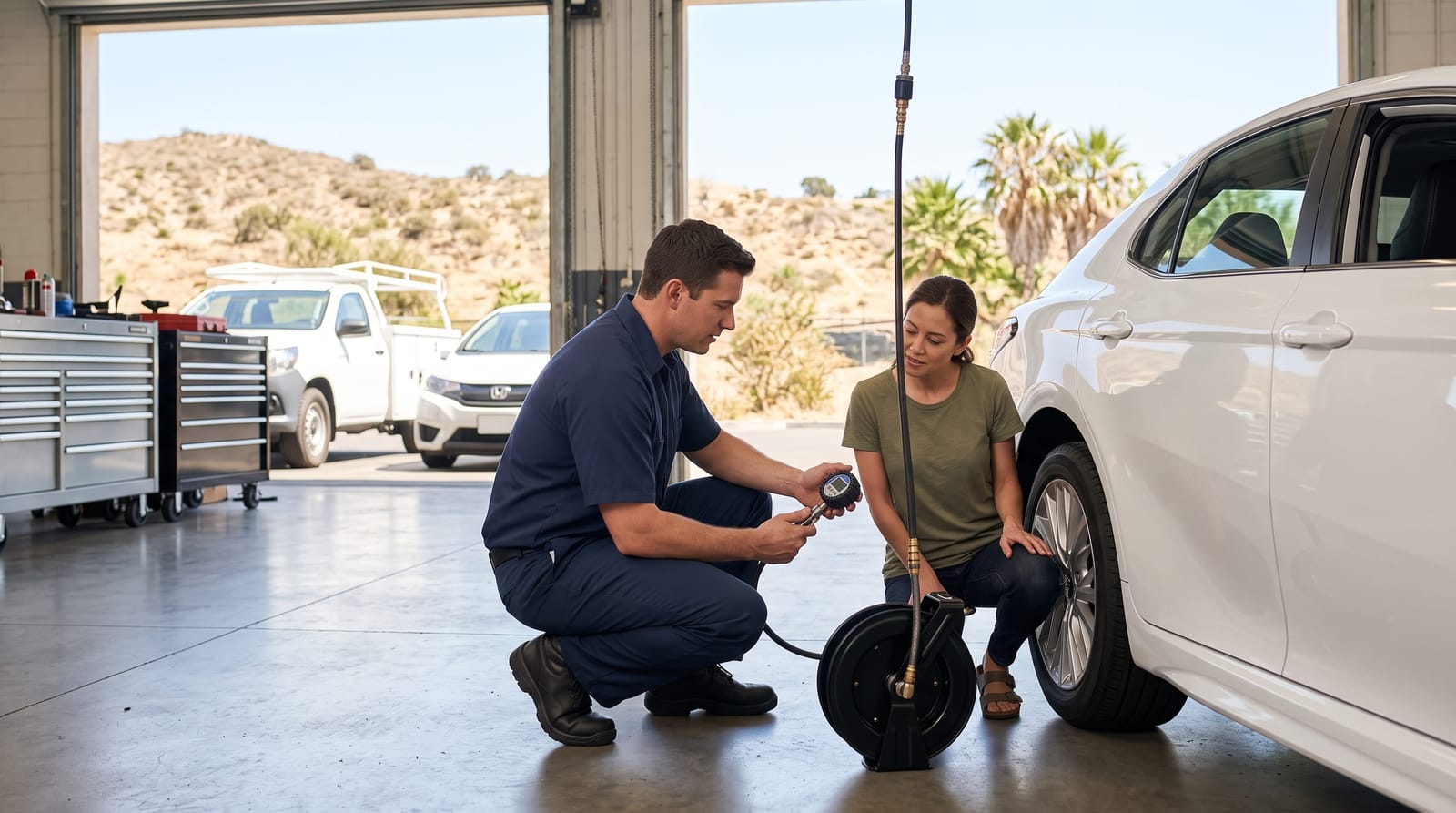
It's worth noting that while your AC is being checked, it's also a good time to confirm that other heat-sensitive systems are in order. For example, hot weather tire pressure in Southern California is another area Inland Empire drivers often overlook heading into summer, since heat causes air pressure to expand and affects handling and fuel efficiency.
When to Schedule Your AC Service
The best time to have your AC checked is before you actually need it: ideally in April or May, before Southern California heat season kicks into full gear. Here's a simple timing guide:
- April-May: Ideal window for a pre-summer AC inspection and any needed service
- June-September: Peak demand: shops get busier, and you're already in the heat
- Any time you notice symptoms: Don't wait for a "scheduled" window if your AC is already underperforming
- Before a road trip: Always confirm AC performance before a long drive in summer heat
As a general rule of thumb, if your AC hasn't been inspected in the past two years or 24,000 miles, it's worth having it looked at before summer, even if it seems to be working fine.
Frequently Asked Questions
How often should car AC refrigerant be recharged?
There's no fixed interval for refrigerant recharges because refrigerant doesn't deplete under normal operation: it only depletes if there's a slow leak. Many vehicle owners go several years or more without needing a recharge. If your AC is blowing warm air or cycling abnormally, that's the signal to have refrigerant levels checked rather than scheduling a recharge on a fixed schedule.
Can I just replace the cabin air filter myself?
On many vehicles, yes: the cabin air filter is accessible without tools, often located behind the glove box or under the hood near the base of the windshield. Your owner's manual will show the exact location. If you're unsure or the location is hard to reach, a quick service visit makes it an easy job that takes just a few minutes.
Will an AC recharge fix all warm-air problems?
A refrigerant recharge fixes the most common cause of warm air output: low refrigerant levels. However, if there's an underlying leak, a clogged expansion valve, or a failing compressor, those will need to be addressed separately. A technician can help identify whether the issue is refrigerant-related or something else during the inspection.
Is it safe to drive with a broken AC in summer heat?
Technically you can drive a vehicle with a non-functioning AC, but it's worth taking the heat seriously, especially in the Inland Empire. Interior temperatures in a parked or slow-moving car can climb dangerously high in Southern California summers. Getting your AC serviced before peak heat is a straightforward step that makes every drive more comfortable and safer for passengers, including children and pets.
Don't Wait Until Summer to Find Out
Your car AC's readiness for a Southern California summer comes down to a few simple things: refrigerant level, cabin air filter condition, and overall system health. Most AC performance issues can be traced back to one of those three areas, and each one is addressable with a routine service visit. The Inland Empire's summer heat is predictable, which means you have a real advantage: you can get ahead of it. Schedule an AC inspection at Rancho Express Lube before temperatures peak and head into summer confident your car is ready for whatever the season brings.