Does Hot Weather Affect Tire Pressure? What Inland Empire Drivers Need to Know
If you've ever walked out to your car on a blazing Inland Empire morning and noticed a dashboard warning light you didn't expect, you're not alone. Hot weather and tire pressure have a direct relationship, and in a region where summer temperatures regularly push past 100°F, that relationship matters more than most drivers realize. As part of keeping your vehicle ready through every season, understanding how heat affects your tires is one of the simplest and most important things you can do. This guide breaks down exactly what's happening inside your tires when temperatures rise, what the warning signs look like, and how to stay ahead of any issues.
How Hot Weather Actually Changes Your Tire Pressure
Tires aren't sealed rigid containers: the air inside them responds to temperature just like any gas does. As temperatures rise, air molecules move faster and expand, which increases the pressure inside the tire. The general rule of thumb is that tire pressure rises approximately 1 PSI (pound per square inch) for every 10°F increase in temperature.
To put that into real-world terms: if you inflate your tires to the recommended pressure on a cool 65°F morning, and then your car sits in a parking lot on a 105°F Inland Empire afternoon, your tire pressure could climb by roughly 4 PSI on its own, before you've even driven anywhere. Add in the heat generated by driving itself, and pressure can increase even further.
This isn't necessarily dangerous on its own, but it becomes a problem if your tires were already at or above the recommended maximum pressure before the temperature climbed. Tires have a maximum pressure rating for a reason, and consistently exceeding it increases wear on the center of the tread and reduces the tire's ability to absorb road irregularities: making for a rougher ride and less predictable handling.
The important takeaway: always check your tire pressure when the tires are "cold", meaning the car has been parked for at least three hours or driven fewer than a mile at low speed. Checking pressure immediately after a drive will give you a falsely high reading that doesn't reflect your true baseline.
The Risks of Running Too Low: Especially in Heat
While over-inflation gets some attention, underinflation is actually the more dangerous condition, particularly during Southern California summers. When a tire is underinflated, its sidewalls flex more than they should as the tire rolls. That flexing generates heat, and when you combine that with already-high ambient temperatures and hot asphalt, the tire's internal temperature can reach levels that stress the rubber and structural materials inside.
Underinflated tires also wear unevenly, with the outer edges of the tread taking on more load than the center. Over time, this reduces the tire's lifespan and can affect how your vehicle handles in emergency situations.
Signs that your tires may be underinflated include:
- A slight sluggishness in steering response
- The vehicle pulling slightly to one side
- Visible bulging or sagging along the bottom edge of the tire when parked
- A TPMS (Tire Pressure Monitoring System) warning light on your dashboard
In extreme heat, allowing a significantly underinflated tire to run at highway speeds increases the risk of a sudden failure. The goal isn't to cause alarm, most tires perform reliably when maintained properly, but to highlight why regular pressure checks matter so much during Inland Empire summers.
Understanding Your TPMS Warning Light
Most vehicles manufactured after 2008 are equipped with a Tire Pressure Monitoring System, commonly referred to as TPMS. This system uses sensors inside each wheel to monitor pressure in real time and alert you when it drops significantly below the recommended level.
What the Light Means
The TPMS warning light looks like a cross-section of a tire with an exclamation point in the center. When it illuminates, it typically means one or more tires have dropped about 25% below their recommended pressure. That might sound like a lot, but keep in mind that tires can lose pressure gradually and still feel normal while driving, which is why the light exists in the first place.
What to Do When It Comes On
If your TPMS light comes on, don't ignore it or assume it will go away on its own. Pull over when it's safe to do so and visually inspect each tire. If none appear obviously flat, drive carefully to the nearest location where you can check the pressure with a gauge and add air if needed. The TPMS light should turn off once pressure is restored to the proper level.
A Note About Seasonal Fluctuations
You may also notice the TPMS light appearing briefly on cold mornings after a warm stretch, or vice versa. Temperature swings between night and day in the Inland Empire can temporarily trigger the light as pressure drops in cooler nighttime air. If the light goes off after you've been driving a few minutes and temperatures have normalized, the pressure may have returned to the acceptable range on its own, but it's still worth checking manually to confirm.
How to Check and Adjust Tire Pressure the Right Way
Proper tire pressure isn't a one-size-fits-all number. The correct pressure for your vehicle is listed on a sticker inside your driver's side door jamb, not on the tire itself. The number printed on the tire sidewall is the maximum pressure the tire can handle, which is a different figure entirely.
Here's a straightforward process for checking your tire pressure:
- Check when tires are cold. Do this first thing in the morning before driving, or after the car has been parked for at least three hours.
- Remove the valve cap from the tire stem (the small rubber or metal nub on your wheel).
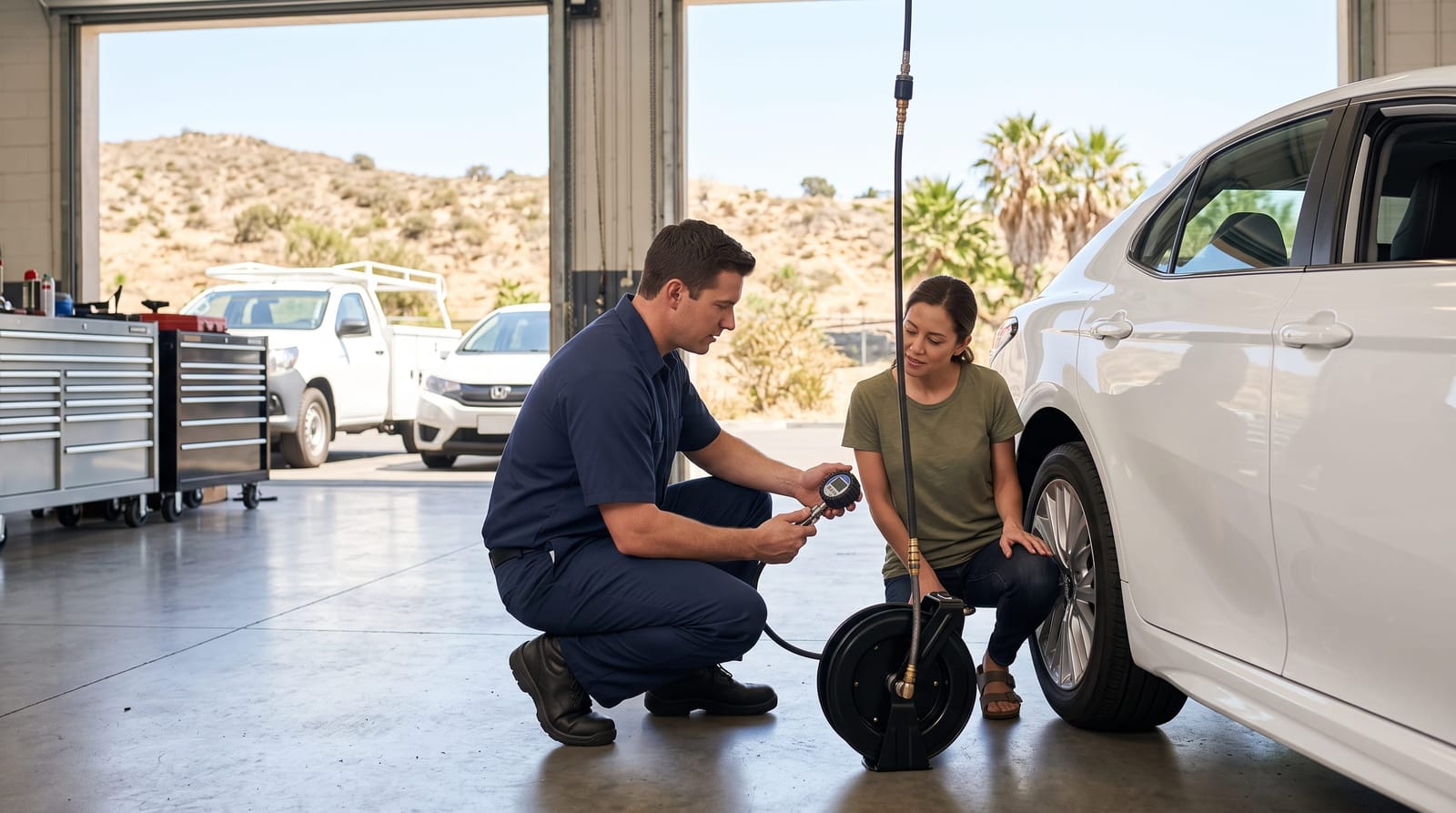
- Press a tire pressure gauge firmly onto the valve stem. A digital gauge gives the most accurate reading, but a basic dial or stick gauge works fine.
- Compare the reading to your door jamb sticker. If the reading is too low, add air. If it's too high, release a small amount by pressing the center pin inside the valve stem.
- Replace the valve cap and repeat for all four tires, plus your spare if your vehicle has one.
Most automotive professionals suggest checking tire pressure at least once a month, and especially before any long road trip. A great habit for Inland Empire drivers is to make tire pressure part of every oil change visit: that way it's checked on a consistent schedule by someone with the right equipment, and you're not relying on memory alone.
Tying It All Together: Seasonal Tire Care in Southern California
Tire pressure is just one piece of a broader seasonal vehicle readiness picture. During summer months in the Inland Empire, your entire vehicle is working harder, from the cooling system managing engine heat to the air conditioning system keeping the cabin comfortable. If you're curious how your AC system holds up in the heat, understanding how to assess your car's AC before summer driving season is a helpful companion topic to this one.
When it comes to tires specifically, heat accelerates wear on rubber that's already aging. If your tires are several years old, have uneven wear patterns, or are consistently running low on pressure, a visual inspection by a qualified technician is a reasonable next step. At Rancho Express Lube, tire pressure checks are part of our routine service process: it's one of the things we look at every time you come in, so you don't have to track it separately.
Staying on top of tire pressure doesn't require a lot of time or mechanical knowledge. It just requires a little consistency, and in summer heat like we see across the Inland Empire, that consistency pays off in reliability, comfort, and confidence on the road.
Frequently Asked Questions
How much does tire pressure increase in hot weather?
Tire pressure increases approximately 1 PSI for every 10°F rise in temperature. In Southern California, where temperatures can swing significantly between morning and afternoon, that can mean a 3-5 PSI increase during a typical summer day, even before the additional heat generated by driving is factored in.
Should I deflate my tires a little before driving in hot weather?
Generally, no. The recommended approach is to inflate your tires to the pressure listed on your door jamb sticker when they are cold, and let normal temperature changes run their course. Over-deflating tires to "compensate" for heat can actually make underinflation, which is the more dangerous condition, more likely. If your tires are consistently reading higher than recommended, it's worth having them inspected.
Can I check tire pressure right after driving?
It's best to check tire pressure when tires are cold, before driving or after the vehicle has been parked for at least three hours. Checking immediately after driving gives a higher reading than your true baseline because the tires have been warmed up by both road friction and engine heat. For an accurate comparison to your door jamb recommendation, a cold check is the standard.
How often should Inland Empire drivers check their tire pressure in summer?
A monthly check is a solid minimum, and many drivers in hot climates find it helpful to check more frequently during peak summer months. Building it into your oil change routine is one of the easiest ways to stay consistent: your service provider will check it as part of the visit, and you'll have a reliable record of where your tires stand over time.
The Bottom Line on Hot Weather and Tire Pressure
Heat and tire pressure are directly connected, and in the Inland Empire, where summer temperatures are no joke, staying aware of that connection is a simple way to protect your vehicle and drive with more confidence. Check your pressure on cold tires, know what your TPMS light is telling you, and make tire inspection a regular part of your maintenance routine. It's a small habit that makes a real difference. For a broader look at keeping your vehicle ready through every season, the Rancho Express Lube seasonal car maintenance guide for Inland Empire drivers covers the full picture from summer heat to winter cold and everything in between.