How Southern California Air Quality Affects Your Vehicle's Air Filters

When you think about keeping your vehicle well-maintained, air filters might not be the first thing that comes to mind. But if you drive regularly in the Inland Empire or anywhere in Southern California, your vehicle's air filters are working harder than they would almost anywhere else in the country. From the thick smog that settles over the San Bernardino Valley to wildfire smoke seasons and the wind-driven dust that funnels through the Cajon Pass, local conditions put real and consistent stress on the filtration systems in your vehicle. Understanding how Southern California's air quality affects your engine air filter and cabin air filter can help you make smarter decisions about maintenance, and keep your vehicle running reliably for the long haul. This guide breaks down the key local factors and what they mean for your car.
Why Southern California Air Is Uniquely Challenging for Vehicles
Southern California has one of the most complex air quality challenges of any region in the United States. The South Coast Air Quality Management District (SCAQMD), which oversees air quality across Los Angeles, Orange, Riverside, and San Bernardino counties, regularly monitors pollutant levels that include ground-level ozone, particulate matter, and airborne dust. The Inland Empire, which includes Rancho Cucamonga, Ontario, Fontana, and surrounding communities, frequently ranks among the most polluted regions in California, not just for smog but also for fine particle pollution (PM2.5 and PM10).
What makes this region particularly challenging is the combination of geography and climate. The mountains to the north and east act as a natural barrier that traps air pollutants in the basin, preventing them from dispersing the way they might in a more open landscape. Stagnant air conditions during summer months cause ozone and particulate levels to build up over multiple days. Add in one of the busiest freight and commercial truck corridors in North America, Interstate 10 and Interstate 15, and you have a consistently high concentration of diesel exhaust, tire wear particles, and road dust in the air your vehicle breathes every single day.
This matters because your engine air filter's entire job is to catch that airborne debris before it reaches your engine. In areas with cleaner air, filters last longer. In areas like ours, they fill up faster. It's that straightforward.
The Role of the Cajon Pass and Wind-Driven Dust
One of the more underappreciated air quality factors in the Rancho Cucamonga area is the Cajon Pass, the mountain gap that channels air and weather patterns between the Mojave Desert and the San Bernardino Valley. During high-wind events, particularly the Santa Ana wind season in late fall and winter, this corridor can funnel significant amounts of desert dust and fine particulate matter into the communities below.
What Wind-Driven Dust Does to Your Engine Air Filter
Engine air filters are designed to trap fine particles before they can enter your engine's intake system. Dust and grit are among the most damaging things that can pass through a compromised or clogged filter because they act as an abrasive inside engine components. During a significant Santa Ana wind event, the concentration of airborne dust can spike dramatically over a very short period: sometimes within hours.
For drivers in Rancho Cucamonga, Fontana, and nearby areas, this means that even a relatively new air filter can accumulate a meaningful amount of debris after just a few high-wind days. If you've driven through a particularly dusty stretch of weather without recently having your filter inspected, it's worth having it checked. A quick visual inspection during a routine oil change appointment is an easy way to stay ahead of this.
High-Traffic Freight Corridors Add to the Problem
The Inland Empire is a major logistics and distribution hub. Thousands of heavy-duty trucks travel through this region daily on the I-10, I-15, and SR-60 corridors. Diesel exhaust from these vehicles contributes significantly to local particulate matter levels, especially in communities close to these highways. If your daily commute takes you along any of these routes, or if you live near a major interchange, your vehicle's filters are being exposed to higher-than-average concentrations of fine soot and exhaust particles on a regular basis.
Wildfire Smoke Season and What It Means for Your Filters
California's wildfire season has become a year-round concern rather than a predictable summer event. When wildfires burn in the region, or even hundreds of miles away in Northern California or Nevada, the smoke can travel significant distances and settle over the Inland Empire for days or even weeks at a time. Wildfire smoke contains a complex mixture of fine particles, ash, and gases that are both an air quality concern for people and a maintenance concern for vehicles.
Your engine air filter and cabin air filter are both affected during heavy smoke events. The cabin air filter, which cleans the air that comes into your passenger compartment through the heating and cooling system, can become saturated with fine smoke particles relatively quickly during prolonged smoke events. For more detail on how wildfire smoke and smog specifically affect how often you should replace your filters, see our post on wildfire smoke car air filter replacement frequency.
The key takeaway here is that wildfire smoke events are not a one-day inconvenience for your vehicle: they can have a cumulative impact on filter life, particularly if multiple smoke events occur within the same season. Drivers who experience several of these events per year without adjusting their maintenance schedule may be running on clogged filters without realizing it.
What National Replacement Intervals Don't Account For
Most vehicle owner's manuals include a recommended replacement interval for the engine air filter: commonly somewhere around every 15,000 to 30,000 miles under normal driving conditions. The phrase "normal driving conditions" is doing a lot of heavy lifting in that sentence.
What manufacturers consider "normal" is typically based on average conditions across a wide range of climates and environments. Southern California, and the Inland Empire specifically, is not average. The combination of chronic air quality challenges, seasonal wildfire smoke, desert dust intrusion, and heavy diesel traffic means that vehicles in this region are operating under what many manufacturers would classify as "severe" or "adverse" driving conditions.
Severe Conditions Often Warrant Shorter Service Intervals
Many owner's manuals include a separate maintenance schedule for severe operating conditions, which often includes dusty environments, stop-and-go traffic, and areas with high air pollution. Under those conditions, the recommended replacement interval for an engine air filter is typically shorter. Checking your owner's manual for the severe-condition schedule, and applying it based on your local driving environment, is a reasonable approach for Inland Empire drivers.
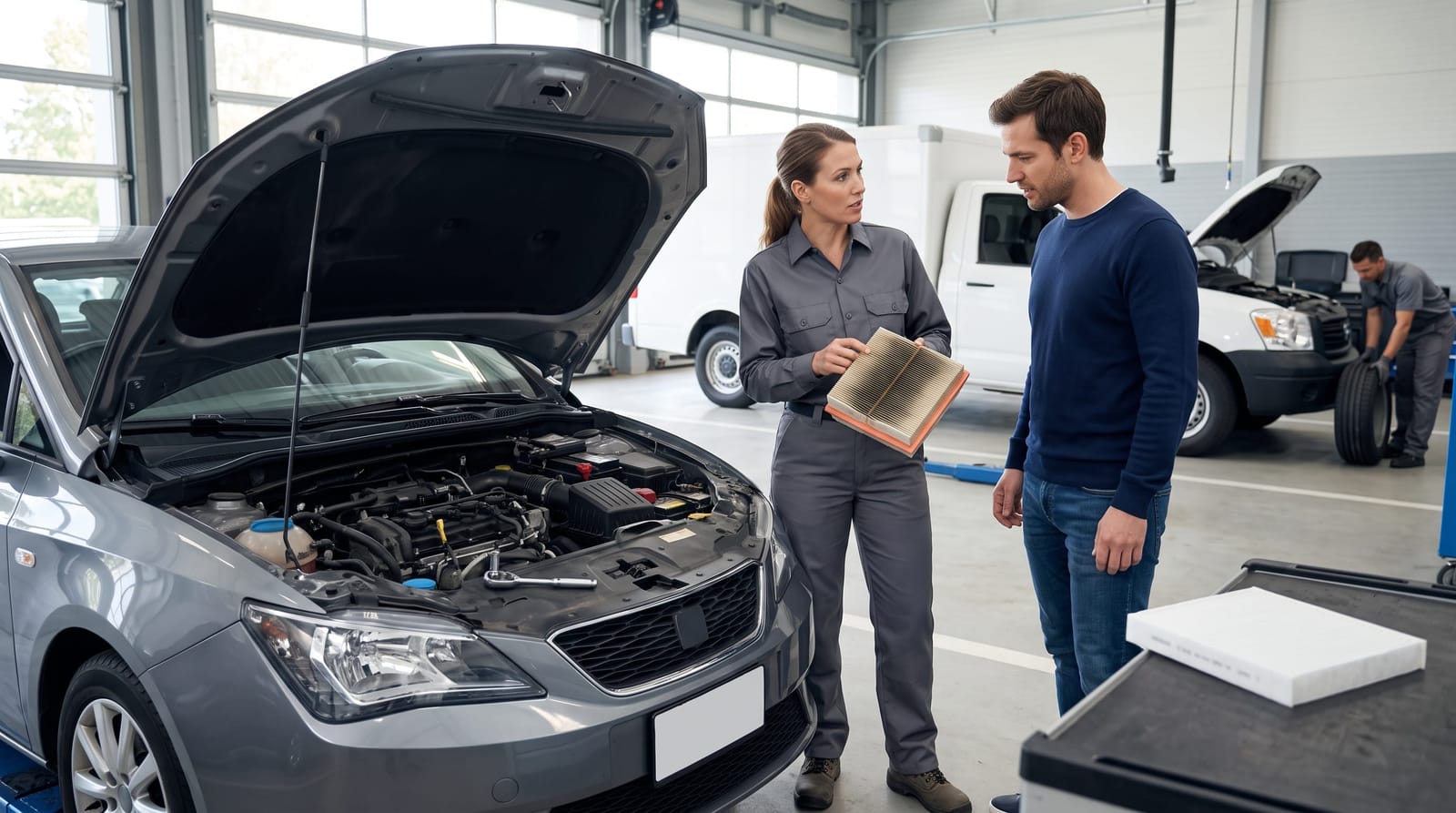
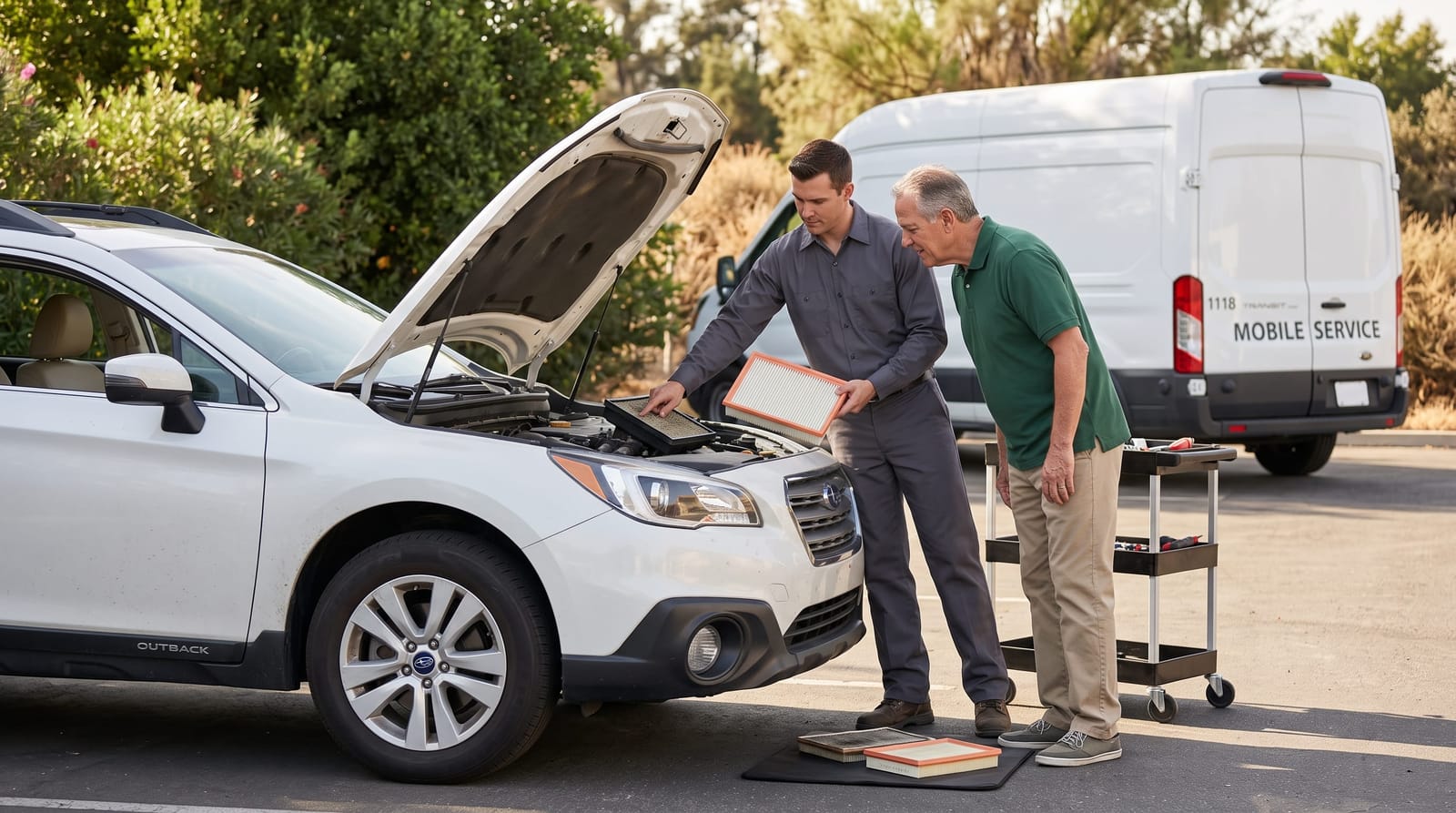
That said, the most reliable way to know whether your air filter actually needs replacing isn't just based on mileage: it's based on a visual inspection. A filter that still looks relatively clean may be fine. One that looks gray, dark, or visibly packed with debris should be replaced regardless of where you are in the mileage interval. At Rancho Express Lube, our service team checks your air filter as part of routine maintenance visits so you always have an up-to-date picture of its condition.
Engine Air Filters vs. Cabin Air Filters: Two Different Jobs, Same Local Problem
It's important to understand that your vehicle has two separate air filtration systems, and both are affected by Southern California's air quality, just in different ways.
Your engine air filter protects the mechanical components of your engine by preventing dust, debris, and particles from entering the intake system. A clogged engine air filter can restrict airflow to the engine, which affects how efficiently the engine runs. It's a wear-and-tear issue at its core.
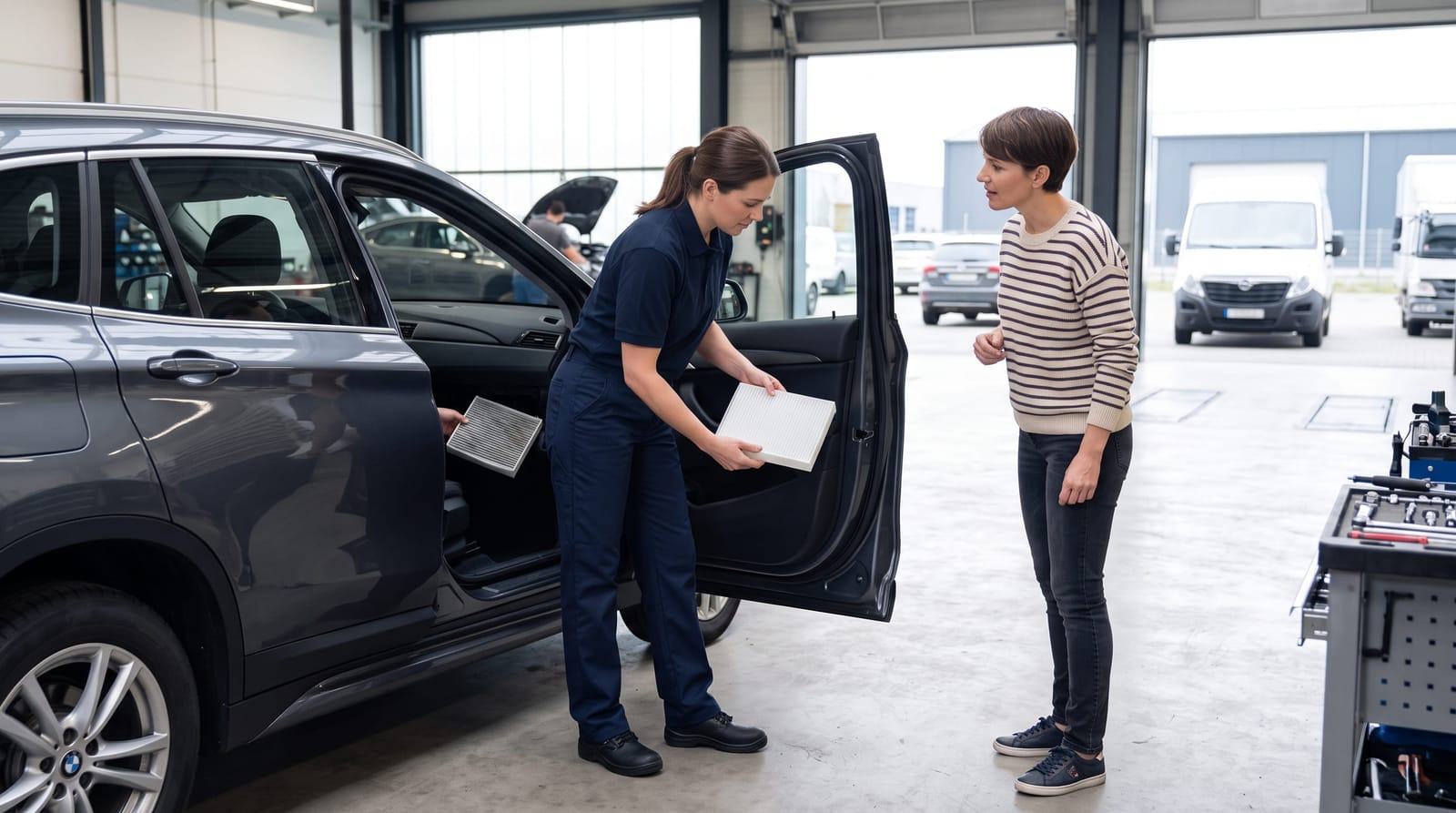
Your cabin air filter is focused on the air quality inside the vehicle itself: the air you and your passengers breathe. It filters out dust, pollen, exhaust particles, and other pollutants before they circulate through the interior. In a region with chronic smog, wildfire smoke events, and high dust levels, this filter genuinely earns its keep. If you've ever wondered whether upgrading to a higher-filtration option makes sense for local conditions, our post on HEPA cabin air filter worth it explores that question in detail.
For a broader look at how a seemingly minor part like an air filter connects to overall engine protection, see our related post on engine air filter replacement Fontana CA, which covers why consistent filter maintenance matters well beyond just air quality. And if you're interested in how cabin filter options vary and what replacement service looks like, our guide to cabin air filter replacement service Ontario CA is a helpful resource.
Practical Steps for Inland Empire Drivers
Given everything covered above, here are practical ways to approach air filter maintenance if you live and drive in the Rancho Cucamonga area:
- Have your air filter inspected at every oil change. A visual check takes very little time and gives you real information about the filter's condition rather than relying purely on a mileage estimate.
- Pay attention to wildfire smoke events. If your area experiences multiple days of heavy smoke in a season, it's worth having both your engine and cabin filters checked sooner than your usual interval.
- Consider your commute route. If you regularly drive near major freight corridors like the I-15 or I-10, your filters are exposed to more diesel particulate matter than drivers in less traffic-heavy areas.
- Don't ignore post-wind-event checks. After a significant Santa Ana wind event or extended dusty conditions, a quick filter inspection is worthwhile.
- Check your owner's manual for severe-condition intervals. Many drivers in this region may qualify for that schedule based on their environment, which typically calls for more frequent filter attention.
Related Topics Worth Exploring
Southern California's air quality creates a unique maintenance environment that touches several specific aspects of vehicle filtration. If you're curious about how smoke events in particular affect replacement timing, the post on wildfire smoke car air filter replacement frequency goes deeper on that topic. If you've been wondering whether a premium filtration upgrade is worth considering given local conditions, the post on HEPA cabin air filter worth it offers a clear-eyed look at what higher-grade cabin filters actually do and when they make sense. For drivers interested in aftermarket engine filter options, performance air filter upgrade worth it breaks down the real-world differences.
Conclusion
Southern California is a beautiful place to live, but it comes with air quality challenges that are genuinely unique to this region. The combination of SCAQMD-monitored smog, wildfire smoke seasons, Cajon Pass dust events, and heavy freight traffic means that vehicles in the Inland Empire are filtering dirtier air more consistently than the national average. That's not a reason for alarm: it's simply a reason to stay informed and keep up with filter maintenance based on your actual local conditions rather than a one-size-fits-all national guideline.
At Rancho Express Lube, we understand the specific conditions that Rancho Cucamonga drivers deal with every day. Our team checks your air filters during routine service visits and gives you honest, straightforward information about their condition. Stop in or schedule a visit: it's one of the easiest ways to stay ahead of a maintenance item that quietly does important work every time you drive.