Seasonal Car Maintenance Guide for Inland Empire Drivers: Get Your Vehicle Ready Year-Round
If you've lived in the Inland Empire for any length of time, you already know the weather here doesn't play by anyone else's rules. Summers push triple-digit temperatures that bake asphalt and engine bays alike. Winter mornings in Rancho Cucamonga and Fontana can dip below freezing, especially at higher elevations. Add in the daily stop-and-go on the 10, the 15, and the 210 freeways, and you've got a driving environment that genuinely puts your vehicle through its paces: season after season.
That's why a car maintenance seasonal checklist built specifically for Inland Empire drivers looks different from a generic one written for, say, a Seattle commuter or a Phoenix snowbird. Your car's needs shift with the calendar, and staying ahead of those shifts is the single most effective thing you can do to avoid unexpected breakdowns, costly repairs, and the kind of roadside stress nobody wants.
This guide covers everything: summer heat preparation, cold-weather readiness, road trip prep, back-to-school vehicle checks, and the year-round maintenance habits that keep vehicles running reliably in Southern California's unique conditions. Whether you're driving a five-year-old sedan or a high-mileage SUV, this is your practical, season-by-season reference for keeping your vehicle in good shape from January through December.
Here's what you'll learn: which services matter most in each season, what warning signs to watch for, how local conditions specifically affect your vehicle's components, and how to build a simple maintenance routine that fits your life without overwhelming your schedule or your budget.
Why Inland Empire Driving Conditions Demand a Seasonal Approach
Generic car maintenance advice is written for a mythical "average" driver in an "average" climate. Inland Empire drivers aren't average, and neither is the climate. Understanding exactly how local conditions stress your vehicle helps you prioritize the right services at the right times: rather than simply following a one-size-fits-all checklist that may not reflect your reality.
Heat Is the Primary Threat
The Inland Empire regularly records summer temperatures between 100°F and 115°F. According to the National Weather Service, the Inland valleys of San Bernardino and Riverside counties average 30 or more days per year above 100°F. That sustained heat affects nearly every fluid, rubber component, and electrical system in your vehicle. Engine coolant works harder. Oil breaks down faster. Tires lose pressure more quickly. Rubber belts and hoses become brittle. Battery fluid evaporates at an accelerated rate.
The AAA reports that vehicle breakdowns spike during summer heatwaves, with battery failures and overheating accounting for a significant portion of roadside service calls during peak temperature periods. In a region like the Inland Empire, where temperatures stay elevated for months at a time rather than a few sporadic days, that risk is sustained, not temporary.
Cold Snaps Are Real Here
Many drivers dismiss winter preparation because they associate it with snow states. But the Inland Empire's high desert geography means nighttime and early morning temperatures in Rancho Cucamonga, Fontana, and surrounding communities can drop into the mid-20s°F during January and February. Elevation communities near the foothills see frost, ice, and occasionally snow. Cold temperatures affect battery performance, tire pressure, and fluid viscosity, all of which matter whether or not you're driving through a blizzard.
Freeway and Stop-and-Go Wear
Inland Empire commuters deal with some of the most congested freeway corridors in California. The combination of sustained highway speeds and repeated stop-and-go cycling puts above-average demands on brakes, transmission fluid, and tires. This wear pattern means certain services, like brake inspections and tire rotations, may need attention more frequently than the standard mileage intervals suggest.
Summer Preparation: Protecting Your Vehicle from Inland Empire Heat
Summer is the season that puts the most direct, measurable stress on vehicles in Southern California. The goal during summer preparation isn't just getting your car ready for one hot week: it's setting it up to handle sustained heat exposure for four to five months.
Engine Cooling System
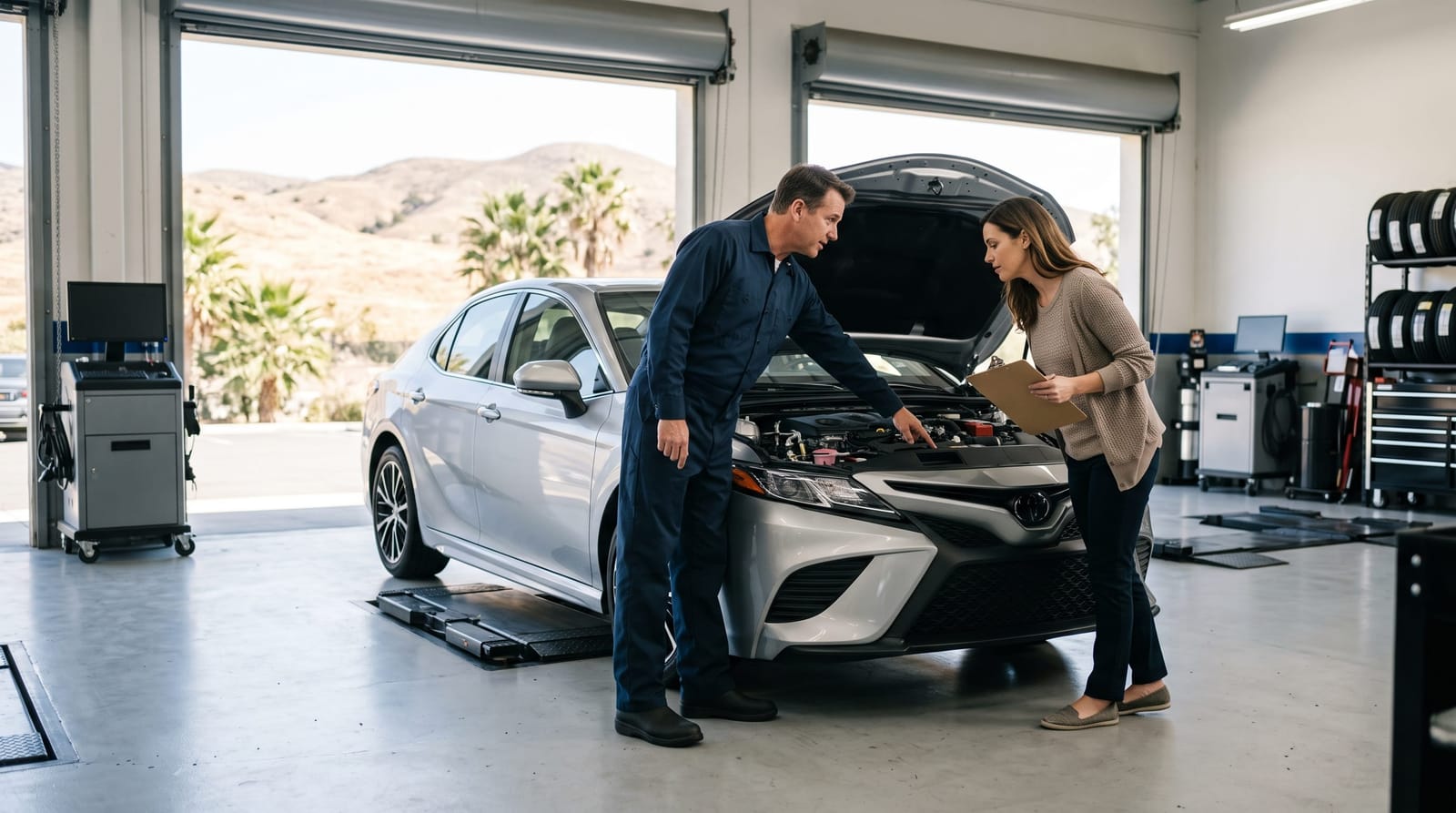
Your vehicle's cooling system is its first line of defense against overheating. This includes the radiator, coolant (also called antifreeze), thermostat, water pump, and associated hoses. Before summer, have the coolant level and concentration checked. Old or depleted coolant loses its ability to transfer heat efficiently. Most manufacturers recommend a coolant flush every 30,000 miles or as specified in your owner's manual, but if you can't remember the last time it was done, summer is the right moment to have it inspected.
Radiator hoses should be firm but flexible. Hoses that feel soft, spongy, or cracked at the connection points are at risk of failure, and a blown radiator hose in triple-digit heat is one of the most avoidable breakdowns there is.
Air Conditioning Performance
Your AC system isn't just a comfort feature in the Inland Empire: it's a safety consideration. A system that blows lukewarm air on a 108°F day creates real risk, especially for young children, elderly passengers, and pets. If your AC isn't cooling as quickly or as effectively as it used to, that's worth addressing before summer peaks rather than after. Low refrigerant is one common cause, but compressor wear and cabin air filter clogs can also reduce performance.
Battery Health in the Heat
Heat is actually harder on car batteries than cold weather. Extreme heat accelerates internal battery fluid evaporation and speeds up the chemical reactions that degrade battery plates. According to the Battery Council International, the average car battery lasts three to five years, and in hot climates, batteries often fall toward the shorter end of that range. If your battery is over three years old, a quick load test before summer is a smart and inexpensive precaution.
Tires and Heat Expansion
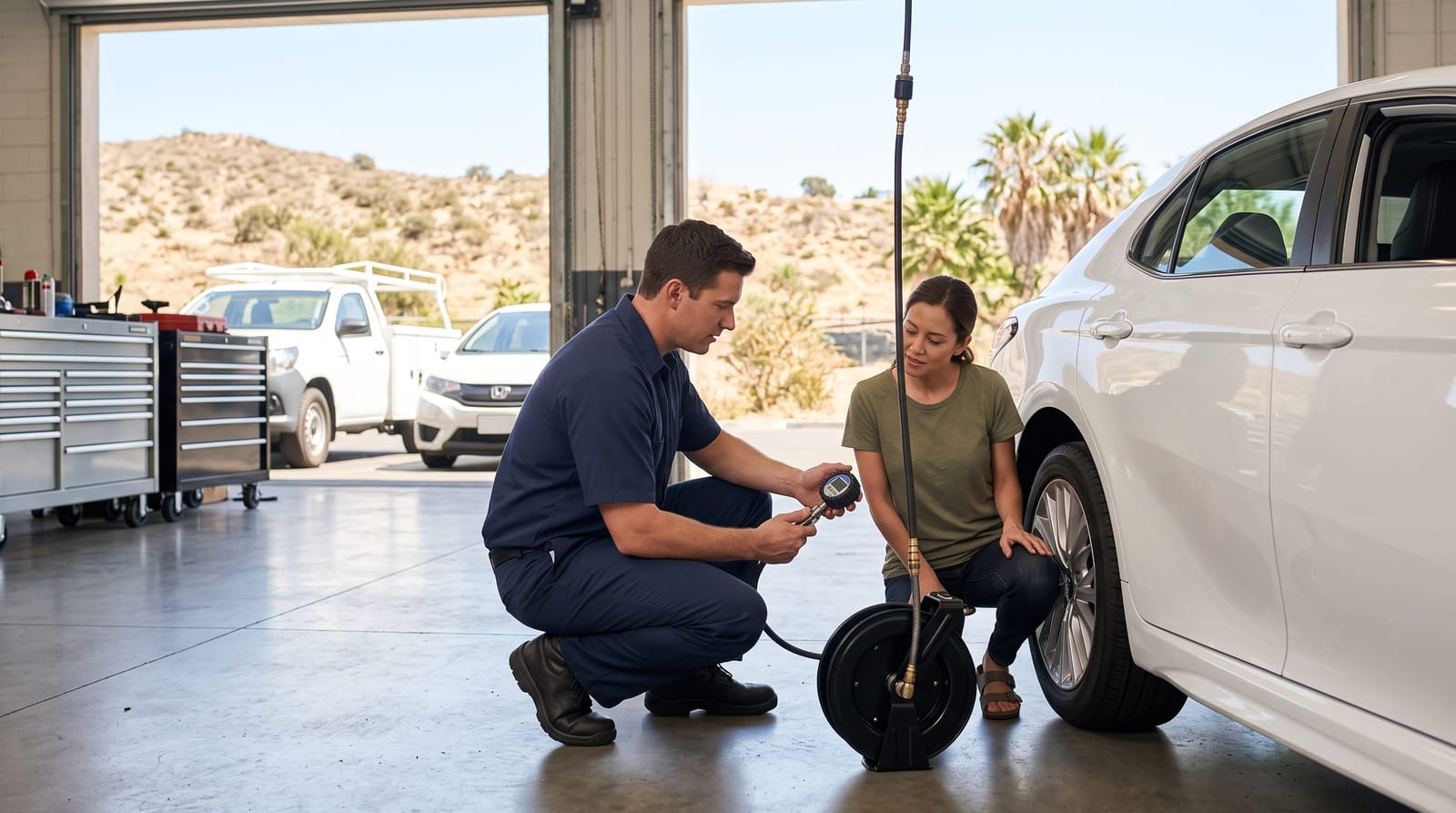
Tire pressure increases roughly 1 PSI for every 10°F increase in temperature. In summer, this means tires that were properly inflated on a cool morning may be overinflated by midday in direct sunlight. Overinflated tires have less contact with the road and wear unevenly down the center of the tread. Check tire pressure in the morning before driving, using the manufacturer's recommended cold pressure, not the maximum PSI molded into the tire sidewall.
For a deeper look at summer-specific maintenance, our guide on summer car maintenance checklist Rancho Cucamonga covers each of these services in detail with Inland Empire-specific context.
Winter Readiness: Cold-Weather Maintenance for Southern California Drivers
It's easy to skip winter vehicle prep when you live somewhere that rarely sees snow. But "winter-ready" in the Inland Empire context means something specific: your vehicle should handle cold starts, temperature swings between 28°F nights and 65°F afternoons, occasional frost, and wet roads, all while continuing to manage daily freeway commutes.
Battery Performance in Cold Weather
Cold temperatures slow the chemical reactions inside a battery, reducing the cranking power available to start your engine. A battery that performs adequately in warm weather may struggle or fail during a January cold snap. The same battery inspection that's smart before summer is equally smart before winter. If a load test shows your battery is holding below 80% capacity, replacing it proactively costs far less than a roadside emergency call on a cold morning.
Oil Viscosity and Cold Starts
Motor oil thickens as temperatures drop. Thicker oil flows more slowly during cold starts, which means engine components may not receive adequate lubrication in those critical first seconds after ignition. If you're using a heavier-weight oil that was appropriate for summer conditions, your service technician may recommend a slightly lighter viscosity better suited to winter cold starts. Your owner's manual will include manufacturer guidance on appropriate oil weight ranges for seasonal temperatures.
Wiper Blades and Visibility
Southern California's rainy season overlaps with winter, typically running from November through March. Wiper blades that streaked or skipped through last year's rain season aren't going to improve with age. The American Automobile Association recommends replacing wiper blades every six to twelve months. Before the first real rain, a quick wiper inspection takes about 30 seconds and can prevent the unpleasant surprise of impaired visibility during a highway downpour.
Tire Tread and Wet Roads
Wet pavement changes the traction equation significantly. Tires with worn tread take longer to stop and are more susceptible to hydroplaning on water-covered roads. The standard tread depth minimum is 2/32 of an inch, but many safety experts recommend replacing tires at 4/32 of an inch for improved wet-weather performance. A simple way to check: insert a quarter into the tread groove with Washington's head pointing down. If you can see the top of his head, the tread is getting low.
Our full guide on winter car maintenance Southern California Inland Empire goes into greater detail on cold-weather fluid checks, heating system inspection, and what Inland Empire drivers specifically need to think about during the cooler months.
Road Trip Preparation: Getting Your Vehicle Ready for Highway Miles
The Inland Empire sits at a natural crossroads, with Las Vegas, San Diego, Los Angeles, and the Arizona state line all within a few hours' drive. Whether it's a spring break trip to Palm Springs, a summer drive to Lake Havasu, or a holiday run to visit family, road trips are a regular part of life here. And a vehicle that handles daily commutes reliably isn't automatically ready for sustained highway driving.
Oil and Fluids Before You Leave
If you're within 1,000 to 1,500 miles of your next scheduled oil change, it's worth doing it before the trip rather than on the road or immediately after returning. Fresh oil handles sustained highway driving better than oil that's already near the end of its service life. Beyond oil, a pre-trip fluid check should include coolant, brake fluid, power steering fluid (if applicable), transmission fluid, and windshield washer fluid, all of which can be quickly inspected during a routine service visit.
Tire Inspection and Pressure
Tires are especially important before highway trips because sustained high-speed driving generates heat buildup. An underinflated tire running at freeway speeds for several hours builds up significantly more heat than a properly inflated one, which increases the risk of a blowout. Before any road trip, check tire pressure (including the spare), inspect for visible damage or uneven wear, and verify that your spare tire equipment is accessible and in working order.
Brakes and Belts
Road trips often include mountain passes, canyon roads, and long descents where brakes work harder than they would during flat-road commuting. If your brakes have been making noise, pulling to one side, or feeling spongy, have them inspected before you leave, not when you're somewhere in the middle of the Mojave with 200 miles still ahead of you.
Emergency Essentials
Every road trip vehicle should carry a basic emergency kit: jumper cables or a portable jump starter, a flashlight with fresh batteries, a reflective triangle or road flare, a basic first aid kit, and water. In summer, carrying extra water is especially important when driving through desert stretches between Southern California and neighboring states.
For a comprehensive pre-departure checklist, our detailed guide on road trip car preparation checklist Fontana CA walks through every item worth checking before you leave the driveway.
Back-to-School Season: Vehicle Safety Checks for Families and Teen Drivers
Late summer, typically late July through early September, brings a predictable surge in driving activity across the Inland Empire. Families are running school supply errands. Teen drivers are returning to school routes they haven't driven in months. Parents with high-mileage family vehicles are logging extra miles between activities. This is one of the most practical windows of the year to do a thorough vehicle checkup, before the school-year rush makes every day feel like a sprint.
Brake Inspection for Family Vehicles
Family vehicles, particularly minivans, SUVs, and larger sedans, carry heavier loads and often see less attentive maintenance during busy household seasons. Brakes should be inspected at least once a year, and the back-to-school period is a logical time to do it. Signs that brakes need attention include squealing during normal stops, a grinding sensation, vibration in the pedal, or the vehicle pulling slightly to one side when braking.
Teen Driver Vehicle Checks
Teen drivers are statistically among the most at-risk groups on the road, and one contributing factor is that they're often the last to notice or report vehicle problems. Before a teen returns to a regular driving schedule, their vehicle should have a basic safety inspection: tires (pressure and tread depth), brakes, lights (all exterior lights including brake lights and turn signals), and battery. These are quick, low-cost checks that provide meaningful peace of mind.
Air Filter and Cabin Air Filter
Late summer in the Inland Empire means wildfire smoke, elevated dust levels, and high pollen counts, all of which affect both engine air filters and cabin air filters. A clogged cabin air filter doesn't just reduce AC efficiency; it affects the air quality inside the vehicle, which matters most when carrying children who may have respiratory sensitivities. Engine air filters that are heavily clogged can reduce fuel efficiency and engine response.
For families preparing teen drivers for a new school year, our guide on back to school car safety check Rancho Cucamonga provides a focused checklist designed specifically for this time of year.
Year-Round Maintenance: The Services That Matter Every Season
Seasonal preparation gets your vehicle ready for specific conditions. But some maintenance items don't wait for seasons: they follow mileage intervals and time-based schedules that repeat throughout the year regardless of temperature or calendar. Building these into a consistent routine is what separates vehicles that reach 150,000 miles in good shape from those that develop expensive problems in the 80,000 to 100,000-mile range.
Oil Changes: The Foundation of Engine Health
Motor oil lubricates, cools, and cleans engine components. Over time and miles, it accumulates combustion byproducts and loses its protective properties. Most modern vehicles with conventional oil are serviced every 3,000 to 5,000 miles, while vehicles using full synthetic oil may go 7,500 to 10,000 miles between changes, though always follow your manufacturer's specific recommendation. In the Inland Empire's heat, oil breaks down somewhat faster than it would in cooler climates, making it worth staying closer to the shorter end of your service interval during summer.
Tire Rotation and Alignment
Tires wear unevenly depending on their position. Front tires on front-wheel-drive vehicles bear the brunt of both steering and acceleration, causing them to wear faster than rear tires. Rotating tires every 5,000 to 7,500 miles (often at each oil change) evens out wear patterns and extends overall tire life. Alignment, which refers to the angles at which your tires contact the road, should be checked annually or after any significant impact, like hitting a pothole at speed or bumping a curb. Misaligned wheels cause uneven tire wear and can affect fuel efficiency.
Brake System Inspections
Brake pads typically last between 25,000 and 65,000 miles, depending on driving style, vehicle weight, and the proportion of city versus highway driving. Inland Empire stop-and-go commuting tends to wear pads faster than pure highway driving. Most shops inspect brake pad thickness during tire rotations: take advantage of that. Brake fluid should also be checked periodically; it absorbs moisture over time, which can lower its boiling point and reduce braking effectiveness under heavy use.
Battery Testing
As mentioned, the Inland Empire's heat accelerates battery aging. Having your battery tested once a year, either in fall before cold weather or in spring before summer, gives you an accurate picture of remaining capacity and helps you plan a replacement before a failure strands you. Most shops can test a battery in just a few minutes.
Fluid and Filter Checks
Beyond oil and coolant, a complete vehicle runs on several other fluids that should be checked at regular intervals: transmission fluid, brake fluid, power steering fluid, and differential fluid (on trucks and all-wheel-drive vehicles). Each has its own service interval, and each plays a specific role in vehicle operation. Air and cabin filters should be replaced as needed: typically every 15,000 to 30,000 miles for engine air filters, and every 15,000 to 25,000 miles for cabin filters, though dusty driving conditions in the Inland Empire may shorten those intervals.
High-Mileage Vehicles: What Changes After 100,000 Miles
A significant number of Inland Empire drivers are managing vehicles with 100,000 miles or more, and with modern vehicles, that milestone doesn't signal the end of a car's useful life. It does, however, signal that certain components deserve closer attention and that maintenance intervals may need adjustment.
Vehicles past the 100,000-mile mark may need attention to timing belt or timing chain service (check your owner's manual for the manufacturer's recommendation), spark plug replacement, suspension component inspection (shocks, struts, and bushings), and transmission service if it hasn't been done. Rubber components, hoses, belts, and seals, have had 100,000 miles of heat and pressure cycles and are worth a thorough visual inspection at this stage.
The good news is that a well-maintained high-mileage vehicle can continue to be reliable transportation well into the 150,000 to 200,000-mile range. The vehicles that tend to struggle past 100,000 miles are usually those that missed oil changes, ignored minor warning signs, or skipped routine services during the preceding years.
For drivers managing vehicles in this mileage range, our dedicated guide on high mileage vehicle maintenance Rancho Cucamonga covers the specific services and inspection points that matter most once you've crossed the six-figure mark.
Building Your Personal Car Maintenance Seasonal Checklist for the Inland Empire
A car maintenance seasonal checklist for Inland Empire drivers doesn't need to be complicated: it just needs to be consistent. Here's a practical framework organized by season and time-based intervals that you can adapt to your specific vehicle and driving habits.
Every 3,000 to 5,000 Miles (Year-Round)
- Oil and oil filter change
- Tire pressure check
- Visual inspection of all exterior lights
- Check windshield washer fluid level
- Inspect wiper blade condition
Spring (March-May)
- Battery load test: assess condition before summer heat arrives
- Coolant level and condition check
- Air conditioning performance test
- Tire rotation and tread depth inspection
- Check brake pad thickness
- Inspect all fluid levels: coolant, brake fluid, transmission fluid, power steering fluid
- Replace cabin air filter if due (especially after allergy season buildup)
Summer (June-September)
- Monitor tire pressure weekly: hot pavement increases pressure
- Check coolant level monthly during peak heat
- Inspect radiator hoses for cracks or soft spots
- Verify AC is cooling effectively before road trips
- Check engine air filter: dust and debris accumulate faster in summer
- Carry emergency water and a basic kit for desert driving
Fall (October-November)
- Replace wiper blades before rain season
- Check brake fluid level and condition
- Battery test: assess cranking capacity before cold mornings arrive
- Inspect tire tread depth before wet-road season
- Check heater and defroster operation
- Top off all fluid levels
Winter (December-February)
- Monitor tire pressure: cold mornings drop pressure by 1 PSI per 10°F temperature decrease
- Check battery if temperatures drop below 40°F regularly
- Verify all lights are working: shorter days mean more driving in low light
- Inspect belts and hoses: cold weather can reveal cracks that weren't visible in heat
- Keep fuel tank at least half full on cold nights: gas-line freeze is rare in Southern California but not impossible at higher elevations
Go Deeper: Seasonal Maintenance Topics for Inland Empire Drivers
This guide gives you a comprehensive foundation for year-round vehicle care in Southern California. The following resources go deeper into each specific season or situation, with detailed checklists, service explanations, and Inland Empire-specific context for each topic.
Summer Heat Preparation
Triple-digit temperatures put unique stress on batteries, cooling systems, tires, and AC. Our dedicated summer car maintenance checklist Rancho Cucamonga guide covers every service worth checking before temperatures climb, and explains specifically why Inland Empire heat affects vehicles differently than other Southern California regions.
High-Mileage Vehicle Care
If your vehicle has crossed the 100,000-mile mark, maintenance priorities shift. Certain components that were optional inspections at 60,000 miles become important service items after six figures. Our guide on high mileage vehicle maintenance Rancho Cucamonga walks through what deserves attention, and what's realistic to expect from a well-cared-for higher-mileage vehicle.
Road Trip Readiness
A well-running commuter car isn't always a road-trip-ready car. Sustained highway speeds, desert heat, and mountain grades each add stress that daily driving doesn't. Our road trip car preparation checklist Fontana CA guide covers the full pre-departure inspection, from fluids and tires to emergency essentials and what to do if something goes wrong on the road.
Winter Maintenance in Southern California
Most Southern California drivers significantly underestimate their winter maintenance needs. Frost, cold-start battery drain, wet roads, and temperature swings all have real effects on vehicle performance. Our guide on winter car maintenance Southern California Inland Empire explains what actually matters for Inland Empire drivers during the cooler months, and what you can reasonably skip.
Back-to-School Vehicle Safety
Late summer is one of the busiest driving periods for Inland Empire families, and for teen drivers returning to regular school routes. Our guide on back to school car safety check Rancho Cucamonga provides a focused vehicle checklist designed for this transition period, including the specific items that matter most for teen drivers and high-mileage family vehicles.
Your Vehicle, Ready for Whatever the Inland Empire Brings
Keeping your vehicle ready for year-round Inland Empire driving isn't about doing everything at once: it's about doing the right things at the right times. Summer means prioritizing heat-related systems: cooling, battery, AC, and tires. Winter means preparing for cold starts, wet roads, and temperature swings. Road trips require a more thorough pre-departure review. And throughout the year, consistent oil changes, tire rotations, and fluid checks form the foundation that everything else builds on.
The practical takeaway from this complete guide is simple: a car maintenance seasonal checklist for Inland Empire drivers is your most effective tool for avoiding breakdowns, extending vehicle life, and keeping your car reliable through every season Southern California throws at it. You don't need to be a car expert to follow it: you just need to check in with your vehicle a few times a year and stay ahead of the small things before they become expensive ones.
At Rancho Express Lube, we understand Inland Empire driving conditions because we work on vehicles from this region every single day. Our team is here to help you build a maintenance schedule that fits your vehicle, your mileage, and your seasonal driving patterns, without pressure, without unnecessary upsells, and without the confusing jargon. Stop in for a quick oil change, ask us what your vehicle is due for, and let's keep your car running reliably for the seasons ahead.